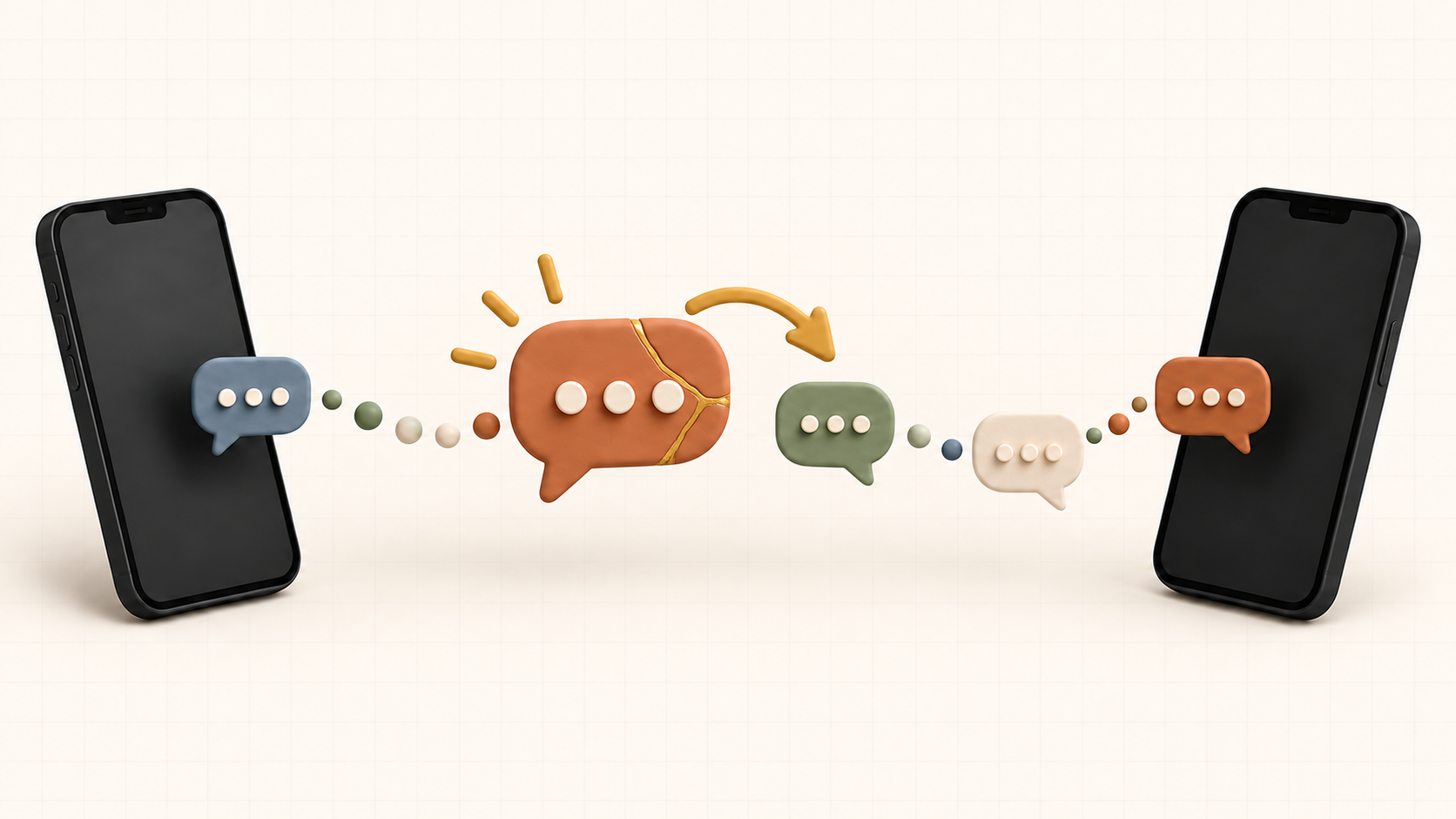
Apologizing to an online friend can feel unusually difficult. You may not see their expression, know how your message landed, or get an immediate reply. That uncertainty can tempt you to overexplain, send several follow-ups, or avoid the conversation entirely.
A sincere apology is not about finding a perfect sentence or persuading someone to forgive you. It is about clearly owning what you did, recognizing its effect, and showing how you intend to do better.
A simple five-part apology
Most thoughtful apologies contain five parts:
- Name what you did. Be specific enough that your friend does not have to explain the problem again.
- Say you are sorry. Use direct language without adding "if" or "but."
- Acknowledge the impact. Show that you understand why the action may have hurt, embarrassed, or disappointed them.
- Offer a realistic repair. Correct what you can and describe the behavior you will change.
- Give them room to respond. An apology does not create an obligation to forgive, reassure, or reply immediately.
A useful starting structure is:
I am sorry for ____. It was wrong because ____. I understand that it may have made you feel ____. I am going to ____. You do not need to respond right away.
Make it sound like you. A short, honest message is usually better than a polished speech that shifts attention back to your intentions.
Should you apologize by text or voice call?
Text is often a good first step because your friend can read it when they feel ready and consider their response without being put on the spot. It also gives you time to remove defensive wording before sending.
For a serious or complicated issue, you can apologize briefly in writing and offer a call: "I want to take responsibility, and I am happy to talk by voice if that would feel better for you." Do not call unexpectedly or insist that a live conversation is the only way to resolve things. If they agree to talk, the same principles from disagreeing respectfully online still apply: listen, stay specific, and avoid trying to win.
15 sincere apology messages for an online friend
These examples are templates, not scripts. Change the details so your apology accurately names what happened.
1. After making a hurtful joke
I am sorry for the joke I made about you. It was unkind, and calling it a joke does not erase the impact. I understand why it hurt. I will not make comments like that again, and I will be more careful not to turn personal things you share into humor.
2. After snapping or reacting defensively
I am sorry for how I responded earlier. I became defensive and spoke to you disrespectfully instead of listening. You did not deserve that. I am going to slow down before replying when I feel upset so I do not take that feeling out on you.
3. After making an unfair accusation
I am sorry I assumed the worst and accused you without asking what happened. That was unfair and put you in a position where you had to defend yourself. I should have checked my understanding first. I will ask rather than jump to a conclusion next time.
4. After disappearing without an explanation
I am sorry I disappeared and left your messages unanswered. I was overwhelmed, but I should have sent a brief message instead of leaving you uncertain. In the future, I will tell you when I need some time away rather than going silent. I understand if you need space from me now.
If a long gap has passed, keep the first contact calm. Our guide to reconnecting with an online friend explains how to reach out without assuming the friendship will return to exactly what it was.
5. After missing a planned call, game, or hangout
I am sorry I missed our plans and did not warn you. Your time matters, and I understand that waiting for me was frustrating. I should have messaged as soon as I knew I could not make it. If you want to reschedule, I will confirm beforehand and let you know promptly if anything changes.
6. After repeatedly replying late despite making promises
I am sorry I kept promising quick replies and then disappearing. I created an expectation I could not consistently meet. I care about our friendship, but I need to be more honest about my availability. I will stop making promises about response times and communicate when I am taking a break.
7. After sharing a private message or screenshot
I am sorry I shared your message without permission. It was private, and I broke your trust. I have deleted the screenshot and asked the person I sent it to to delete it too. I will not share your messages again without asking first. I understand that rebuilding trust may take time.
Do not claim you have fully fixed the situation if copies may still exist. State exactly what you have done and what remains outside your control.
8. After sharing someone else's personal story
I am sorry I repeated something personal you told me about the situation. It was not my story to share, and I put your privacy at risk. I have corrected what I can, and I will treat personal information as private unless you clearly say it is okay to share.
If this happened because conversations became too personal too quickly, review ways to stop oversharing online without becoming distant or ashamed.
9. After embarrassing them in a group chat
I am sorry I called attention to you in the group chat. I can see how that embarrassed you and made the space feel uncomfortable. I should have spoken to you privately. I will not bring up personal issues publicly again. If you want, I can also correct my comment in the group without sharing more details.
10. After crossing a boundary
I am sorry I kept asking after you said you did not want to talk about it. You were clear, and I did not respect your boundary. I will not bring it up again. You do not need to explain or justify that limit to me.
A boundary is information about what someone will participate in, not the start of a negotiation. Learn more about setting boundaries in online friendships.
11. After giving unwanted advice or dismissing their feelings
I am sorry I jumped into advice and treated your feelings like a problem to solve. You were trying to be heard, and I did not listen well. Next time I will ask whether you want support, ideas, or simply someone to stay with you in the conversation.
Our guide to being a better listener online offers practical ways to respond without taking over.
12. After making the friendship feel one-sided
I am sorry I have mostly reached out when I needed support and have not shown the same interest in what you are going through. That was unfair and exhausting. I want to become more consistent about checking in and listening, without expecting you to carry every conversation. I understand if you need some distance.
13. After lying or exaggerating an important detail
I am sorry I lied about ____. The truth is ____. You deserved honesty, and I understand this may change how much you trust me. I will answer reasonable questions honestly, but I will not pressure you to believe me or move past it quickly.
Avoid adding new half-truths to make the confession seem smaller. If revealing the truth could put anyone in danger, seek help from a trusted person rather than improvising a risky disclosure.
14. After failing to support them when you said you would
I am sorry I did not support you when I said I would. I left you feeling alone at a moment when you expected me to be there. I should not have made a commitment I could not keep. Going forward, I will be honest about what I can do instead of promising more than I can offer.
15. After a long time has passed
I have been thinking about how I treated you, and I am sorry for ____. It was wrong, and you did not deserve it. I am not writing to ask you to reassure me or restart the friendship. I wanted to take responsibility. You do not owe me a response.
Only send a late apology if contact is still welcome. Do not use another account, involve mutual friends, or bypass a block. Respecting no contact is part of taking responsibility.
What not to say in an apology
Certain phrases can make an apology feel like another argument:
- "I am sorry if you were hurt." This questions the impact instead of owning the action.
- "I am sorry, but you also..." A counterclaim belongs in a separate conversation, not inside your apology.
- "We both made mistakes." Even if true, begin with your own behavior.
- "I am the worst person ever." Extreme self-criticism pressures your friend to comfort you.
- "Please tell me you forgive me." Forgiveness cannot be a condition of your apology.
- A flood of messages. Repeated explanations can become pressure when someone needs space.
- A public gesture or gift. Repair should fit the harm; it should not create an audience or obligation.
An explanation can provide context, but it should not erase responsibility. Compare "I ignored you because I was stressed" with "I was stressed, but I should have told you I needed space instead of ignoring you."
What to do after you apologize
The message is only the beginning. If you shared something private, delete what you control and correct the disclosure. If you repeatedly broke plans, stop making plans you cannot keep. If you ignored a boundary, respect it without requiring reminders.
Your friend may accept the apology, ask questions, express anger, request space, or end the friendship. Listen to the answer without arguing about whether their reaction is fair. If they name additional harm, you can acknowledge it without immediately defending your intent.
If they do not reply, send no more than one brief, non-urgent follow-up when appropriate, then stop. Silence is not permission to contact them through other channels. If the friendship ends, getting over an online friend can help you process the loss without reopening unwanted contact.
What if both of you were wrong?
You can take responsibility for your part without accepting blame for everything. Apologize first without attaching a demand:
I am sorry for raising my voice and insulting you. That was wrong. I would like to discuss what happened between us when we are both ready, but I do not want my concerns to take away from this apology.
If the other person responds with threats, humiliation, manipulation, or pressure to reveal private information, step back. An apology does not require you to surrender your own boundaries or remain in an unsafe conversation.
Frequently asked questions
How long should an apology text be?
Long enough to name the action, acknowledge the impact, and explain the repair. For many situations, one thoughtful paragraph is enough. A very long message can unintentionally ask the recipient to manage your emotions.
Should I apologize even if I did not mean to hurt them?
Yes, if your action caused harm. You can clarify your intention without using it to dismiss the impact: "I did not intend that meaning, but I understand why my words hurt, and I am sorry."
What if my online friend will not accept my apology?
Accept their decision. You can still learn from what happened and change your behavior. A sincere apology offers repair; it does not guarantee reconciliation.
Is it okay to apologize more than once?
If your first message missed an important part, one clearer apology may help. Repeating the same apology after someone asks for space usually adds pressure rather than repair.
Can an online friendship recover after broken trust?
Sometimes, but trust is rebuilt through consistent behavior over time. Let your friend decide what contact feels comfortable, follow through on commitments, and do not demand a deadline for things to feel normal again.
The best apology is clear, proportionate, and followed by change. Own your part, make the repair you can, and give your friend the freedom to choose what happens next.