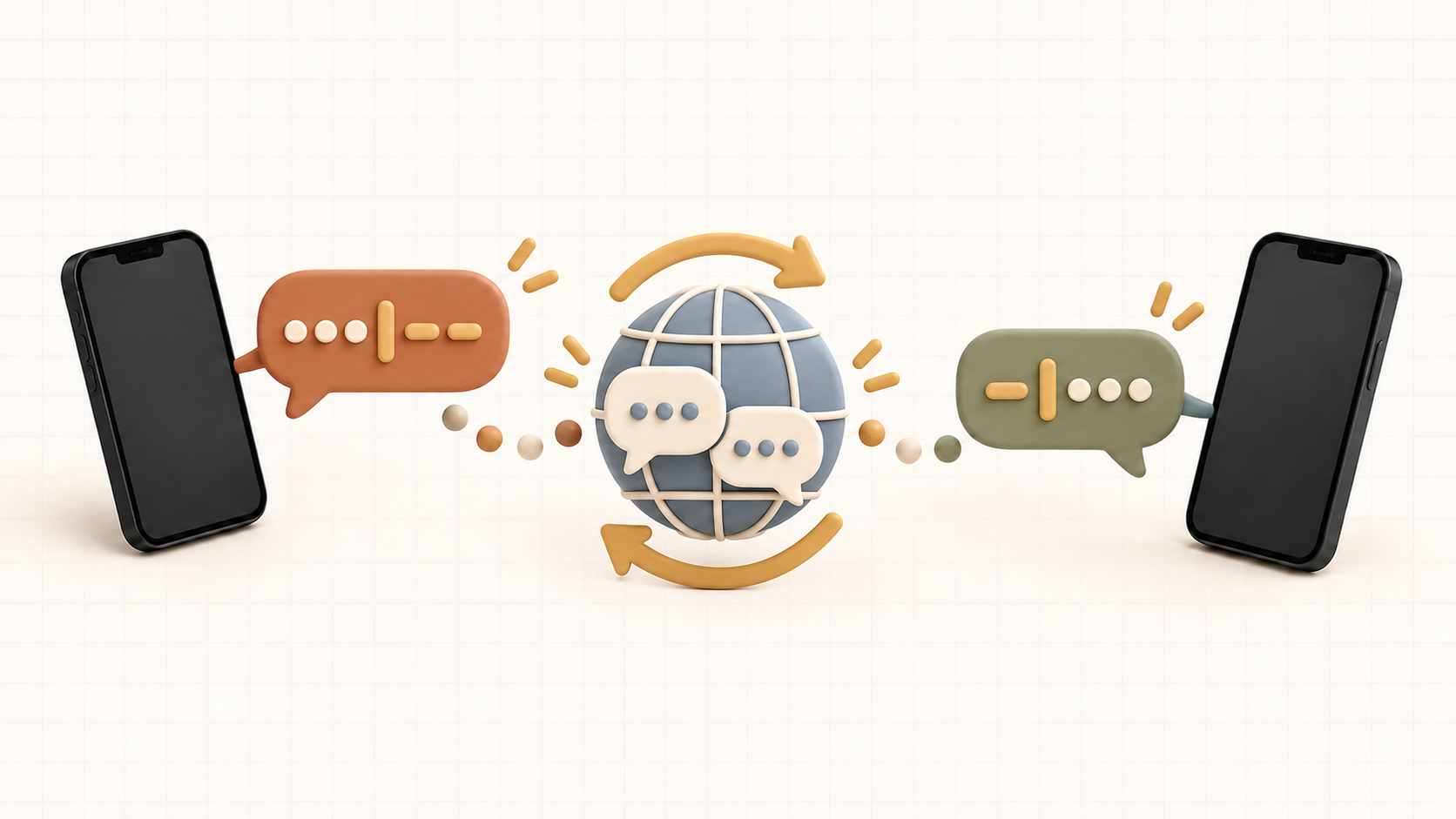
A language barrier does not prevent an online friendship from becoming meaningful. It changes the pace and asks both people to become more deliberate about clarity, patience, and checking what they understood.
The goal is not flawless grammar. It is shared meaning. A friend who pauses to find a word, uses a translator, or asks you to repeat something is making an effort to stay in the conversation.
These ten practices can make that effort more balanced and reduce the misunderstandings that happen when two people do not share the same strongest language.
A language difference is not a lack of personality
Someone may sound quieter, more formal, or less funny in a language they are still learning. Their messages might be shorter because each sentence takes time to compose, not because they are uninterested.
Avoid measuring intelligence, warmth, or effort through grammar and vocabulary alone. Think about how much of your own humor, tone, and precision would disappear if you had to communicate in a language you barely knew.
At the same time, language should not be used to excuse pressure, insults, or ignored boundaries. If a message feels uncomfortable, clarify once when safe, then respond to the behavior you can observe.
1. Agree on the language or combination you will use
Do not assume one person should carry the entire conversation in their second language. Ask what feels workable:
Would you rather chat mostly in English, mostly in Spanish, or each use the language we know best and translate when needed?
Possible arrangements include:
- One shared language for most messages
- Each person writing in their strongest language
- Alternating languages for different days or topics
- A shared language with occasional native-language phrases
- Text for detailed conversation and voice for simple practice
The arrangement can change as skills and comfort grow. Choose communication, not a test.
2. Use clear language without talking down to them
Clear writing is direct, not childish. Use ordinary words, complete thoughts, and a natural tone. Avoid deliberately broken grammar or exaggerated simplicity.
Instead of:
You understand? I say movie good. Very funny.
Try:
I liked the movie because the dialogue was funny. Did the jokes translate well in your version?
Respect is audible even in simple sentences. Speak to your friend as an equal who happens to know different words.
3. Put one main idea in each message
Long paragraphs with several questions, topic changes, abbreviations, and jokes can be difficult to translate. Break complicated thoughts into logical pieces without sending a rapid stream of fragments.
For example:
I can play on Saturday. My evening is probably your morning. Would 9:00 a.m. in your time zone work?
This is easier to answer than a message that combines the plan, a story about your week, three possible times, and an unrelated question.
When an exact detail matters, state the date, time zone, name, or choice explicitly rather than relying on context.
4. Treat translation tools as helpers, not final authorities
Translation can provide a useful first draft or explain an unfamiliar phrase. It can also flatten tone, choose the wrong meaning, mishandle slang, or make a friendly message sound unusually formal.
For important messages:
- Write one clear idea at a time.
- Translate it.
- Translate the result back into your language as a rough check.
- Remove slang or ambiguous wording if the meaning changed.
- Tell your friend when a translation may be imperfect.
Do not paste highly sensitive personal, financial, medical, legal, work, or account information into a translation service without understanding how that service handles data. Use the minimum information needed and review its privacy terms.
5. Check meaning instead of pretending to understand
Saying "yes" may feel polite in the moment, but hidden confusion often becomes a bigger problem later. Make clarification normal for both people.
Useful phrases include:
I understand the first part, but I am not sure what ____ means here. Could you say it another way?
I think you mean ____. Is that correct?
The translator gave me two possible meanings. Which one fits what you wanted to say?
I may have explained that badly. Let me try a shorter version.
Ask focused questions instead of repeatedly saying "What?" The guide to being a better listener online offers more ways to reflect meaning without taking over the conversation.
6. Ask before correcting their language
A friendship is not automatically a lesson. Constant correction can make every casual message feel like homework and discourage the person from expressing anything complicated.
Ask what kind of help they want:
When we chat, would you like me to correct mistakes, correct only mistakes that change the meaning, or focus on the conversation unless you ask?
If correction is welcome, respond to the idea first. Then offer one useful adjustment rather than rewriting the entire message.
That sounds like a great trip. One small note: people usually say "I went there last year" rather than "I go there last year."
Invite the same choice for yourself. Mutual learning feels different from one person acting as the permanent teacher.
7. Explain slang, idioms, humor, and sarcasm
Phrases such as "break a leg," "I'm dead," or "that went over my head" may translate literally and create confusion. Sarcasm can be especially difficult when the reader cannot hear tone.
Early in the friendship:
- Prefer literal wording when the topic matters
- Add context after an idiom
- Avoid teasing that depends on subtle tone
- Explain a joke without making the other person feel foolish
- Ask how a phrase is normally used in their culture
You can still share humor. Treat misunderstandings as an expected part of learning how each other communicates.
8. Add emotional context to important messages
Short translated messages can sound colder or angrier than intended. When tone matters, name it directly:
I am asking because I am curious, not because I am upset.
This is meant as a light joke. Tell me if it does not translate well.
I need some quiet time today, but I am not angry with you.
I disagree with the idea, but I am not criticizing you as a person.
Clear emotional context is particularly useful during disagreement. Follow the steps in how to disagree respectfully online and avoid relying on clever phrasing when a direct sentence will be safer.
9. Try different formats without forcing them
Text gives both people time to translate and think. Voice notes reveal pronunciation and tone. Images, reaction symbols, shared activities, and screen examples can supply context that words miss.
Different formats also create different risks and demands. Ask before sending voice notes, calling, requesting photos, or turning on video. Do not interpret reluctance as dishonesty.
A gradual progression might be:
- Clear text messages
- An occasional approved voice note
- A short planned audio call
- More complex formats only when both people want them
If you decide to try live audio, these first voice-call tips can reduce pressure.
10. Balance the communication work
If one person always translates, simplifies, corrects, schedules, and keeps the conversation moving, the friendship may become exhausting. Both people can contribute even when their language levels differ.
Balance might look like:
- Taking turns using the less familiar language
- Sharing the task of checking unclear phrases
- Letting either person pause when translation becomes tiring
- Choosing activities that do not require constant complex speech
- Learning a few useful phrases in each other's languages
- Thanking effort without praising someone as if they are a child
Do not demand that your friend teach you their language for free. They may enjoy exchanging knowledge, but that should be discussed rather than assumed.
Conversation starters across a language barrier
Topics grounded in concrete experiences are usually easier than abstract questions. Try:
What is a food from your area that you would recommend to someone visiting?
Is there a word in your language that you wish translated more easily?
What music have you listened to this week?
What is one ordinary part of your day that is different from what people expect?
Do you want to choose one photo prompt and compare what we notice?
Avoid treating your friend as a representative for an entire country or language. Ask about their experience, not what "all people there" think. For more ideas, use these questions to get to know someone online selectively rather than sending a list.
What to do after a translation misunderstanding
Pause before assigning intention. Quote the specific wording and explain how you understood it:
When I translated your message, it sounded like you were saying ____. Is that what you meant?
Give the person a chance to restate the thought in simpler words, their strongest language, or another format. You can also explain which word created the ambiguity.
If you realize your own message caused harm, do not blame the translation tool alone:
My translation communicated something harsher than I meant, and I should have checked it before sending. I am sorry. What I wanted to say was ____.
Use the structure in how to apologize to an online friend when the impact goes beyond a minor wording mistake.
Language choices in an online group chat
Group conversations become harder when members do not share the same language. Follow the group's stated language rules and use its translation features or designated language channels when available.
If everyone shares one language, using it for the main discussion helps people participate. Short side exchanges in another language may be fine, but extended conversation can unintentionally exclude members who cannot follow it.
Provide a summary when useful, avoid mocking mistakes, and do not appoint a multilingual member as the group's unpaid translator. Our guide to making friends in an online group chat covers participation and group norms in more detail.
Keep privacy and safety separate from language ability
A person who struggles with your language is not automatically suspicious, and fluent language is not proof that someone is safe. Evaluate behavior over time.
Protect identifying information, accounts, exact location, financial details, and private images regardless of how friendly the conversation feels. Do not open unknown translation files, install software from a stranger, or enter credentials on a link they send.
If someone claims they need money because language or location prevents them from getting local help, do not pay. Follow the steps for an online friend asking for money.
For broader global-friendship guidance, including cultural curiosity, time zones, and safety, read how to make friends from other countries online.
Frequently asked questions
Can two people be close friends without speaking the same language fluently?
Yes. Clear messages, translation support, shared activities, patience, and mutual effort can build a meaningful friendship. Both people should be able to clarify misunderstandings and communicate boundaries.
What is the best way to talk to an online friend who speaks another language?
Agree on a language arrangement, use short natural sentences, keep one main idea in each message, and ask focused clarification questions. Use translation as support rather than assuming every output is exact.
Is it rude to correct an online friend's grammar?
It can be if they did not ask. Discuss whether they want corrections and what type. When correction is welcome, respond to their meaning first and keep feedback limited and respectful.
Should we each write in our own language?
That can work if both people have reliable translation access and prefer the arrangement. It may allow more complete self-expression, but important messages still need clarification because translation can miss tone and context.
Are voice notes better than translated text?
They can communicate tone and support pronunciation practice, but they are harder to translate and may reveal background information. Use them only when both people are comfortable.
What if conversations take a long time?
Slower conversation is normal when people are translating or searching for words. Use asynchronous messages, reduce the number of questions in each reply, and take breaks before communication becomes tiring.
What if only one person is making an effort?
Describe the imbalance directly and ask what kind of communication is realistic. Language differences explain some difficulty, but a sustainable friendship still requires interest, respect, and contribution from both people.
A language barrier becomes easier when neither person treats it as one person's defect. Choose clarity over cleverness, curiosity over assumptions, and mutual effort over perfect sentences.